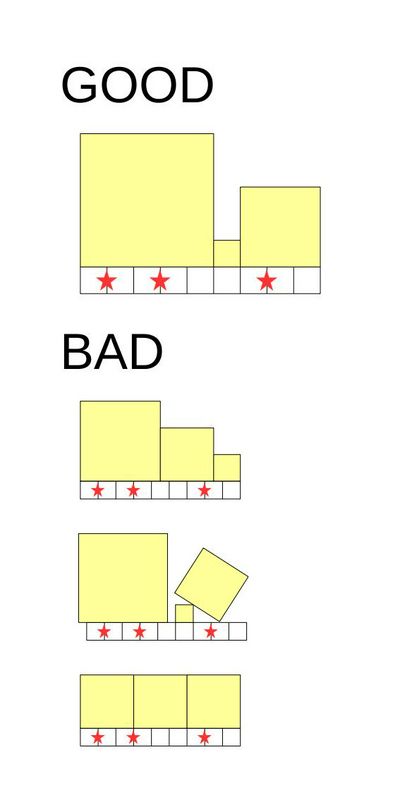
1
2
3
4
5
6
7
8
9
10
11
12
13
14
15
16
17
18
19
20
21
22
23
24
25
26
27
28
29
30
31
32
33
34
35
36
37
38
39
40
41
42
43
44
45
46
47
48
49
50
51
52
53
54
| #include<bits/stdc++.h>
#define fo(i,a,b) for(int i=a;i<=b;i++)
using namespace std;
typedef long long LL;
const int maxm=1e5+5;
const LL mo=1e9+7;
struct ARR{
LL n[3][3];
};
ARR re;
ARR operator * (const ARR &a,const ARR &b)
{
fo(i,0,2)
fo(j,0,2)
{
re.n[i][j]=0;
fo(k,0,2) (re.n[i][j]+=a.n[i][k]*b.n[k][j])%=mo;
}
return re;
}
int m;
LL n,x[maxm];
ARR C,ans;
void mi(LL y)
{
for(; y; y>>=1, C=C*C) if (y&1) ans=ans*C;
}
int main()
{
scanf("%lld %d",&n,&m);
fo(i,1,m) scanf("%d",&x[i]);
x[++m]=n;
sort(x+1,x+1+m);
ans=(ARR){{{1,0,0},{0,0,0},{0,0,0}}};
x[0]=-1;
fo(i,1,m)
{
LL len=x[i]-(x[i-1]+1);
C=(ARR){{{1,2,1},{0,1,1},{1,2,2}}};
mi(len);
if (i==m) break;
C=(ARR){{{1,2,1},{0,1,1},{0,0,1}}};
ans=ans*C;
}
printf("%lld\n",ans.n[0][2]);
}
|